

Suppressors vs. Compensators for Glocks: Which Is Best for You?
May 7th 2026
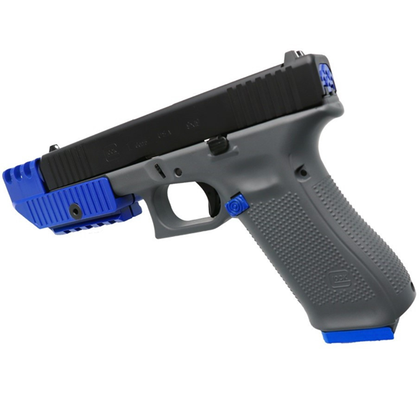
If your Glock has a threaded barrel and all you have on there is a thread protector, you’re really missing out.
You can customize and tailor the performance of your Glock handgun with respect to recoil, muzzle jump, volume, and more, all with the addition of a basic muzzle device.
Two of the most popular of these are suppressors and compensators for Glocks. Here’s what you should know.
How a Suppressor Works
Though they are properly known as suppressors, and go by a ton of other names including silencers and cans, these are muzzle devices that primarily aim to make the gun quieter.
There are many different types of silencers, to keep things as basic as possible, the basic form of a suppressor is a hollow metal muzzle device that has a chamber of internal vanes called baffles.
When the high-pressure gasses behind a bullet expand into these chambers, the baffles redirect the expansion of the pressure and moderate the release of pressure at the muzzle, capturing some of it.
As a result, suppressors help control the volume of a gun, as well as the muzzle pop, though they do offer other benefits as well.
What Suppressors Offer
If you’re thinking that a suppressor for your Glock might be the best option, here are a few things to know:
- While the main advantage of suppressors is that they reduce muzzle pop and noise, most can reduce felt recoil by a small margin, usually somewhere around 10%, but sometimes as much as 30%.
- Since suppressors increase bore pressures, they can also add a few FPS to your muzzle velocity.
- One of the main advantages of suppressors is that they make the gun quieter, protecting your hearing, especially in enclosed spaces.
- Suppressors will considerably alter the footprint of a gun, so if you do outfit your Glock with one, you might need a special holster.
- Since suppressors increase bore pressures, you will likely need to clean your Glock more frequently, as a suppressed handgun will produce more fouling.
- Suppressors are NFA items, which means you will need to do additional paperwork to get one.
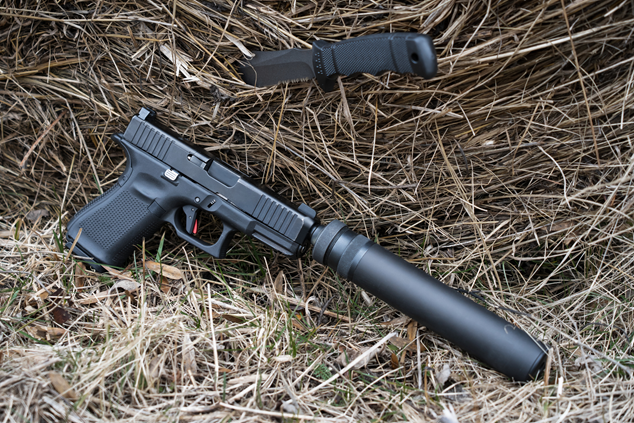
How a Compensator for a Glock Works
Compensators for Glocks are also muzzle devices, though they work in a different fashion from suppressors.
The most basic form of a compensator for a Glock is a metal muzzle device that has ports that redirect gasses where they are vented at the muzzle.
Most compensators either port gasses directly upward, or else they vent them upwards at an angle to split the sight picture. Though they are not common on handgun compensators, some rifle muzzle brakes are “radial muzzle brakes” which instead disperse gasses 360° around the muzzle.
Because most compensators for Glocks port gasses directly upwards, they can have a significant impact on felt recoil, as well as an even more significant impact on muzzle flip.
A good compensator for a Glock can, holding all else equal, reduce felt recoil by as much as 50% without adversely affecting shot power. At the same time, a compensator can significantly cut back on muzzle flip, keeping your sights trained on target for faster, more confident, more accurate follow-up shots.
What Compensators Offer
If you’re considering a compensator for your Glock, here are some of the main things to keep in mind:
- The main advantage of a compensator is that it will reduce felt recoil, in some cases by as much as 50%. Compensators do this without affecting shot power.
- Compensators, like muzzle brakes, reduce muzzle flip, which helps keep your sights on target.
- Compensators are not considered NFA items so fewer regulations apply to them, and they are more accessible to most shooters.
- While suppressors make a gun quieter, compensators will actually make a gun considerably louder, making hearing protection even more important.
- Many compensators are compatible with Glock handguns and do not require any additional modifications to the gun.
- Compensators generally will not alter the footprint of a handgun as dramatically as silencers will, but you still might need a special holster if you install a compensator.
Which Is for You?
There are strong uses cases, and arguments to be made for, both compensators and suppressors for Glock handguns. As in so many other areas in life, this is not a question of whether one is better than the other, but a question of which is better given your intended use case.
For those of you thinking that a compensator is the best muzzle device for your Glock handgun, check out our collection. We carry compensators for Glock pistols that are not just easy to install, they will reduce felt recoil and muzzle jump considerably.
Check out our collection and get in touch with us directly if you have any questions about compatibility or installation.